
Dental Implant FAQs
Considering dental implants? Here you’ll find answers to the most common questions about the treatment, costs, recovery and long-term results. We want you to feel informed and confident when making the right decision for your smile.

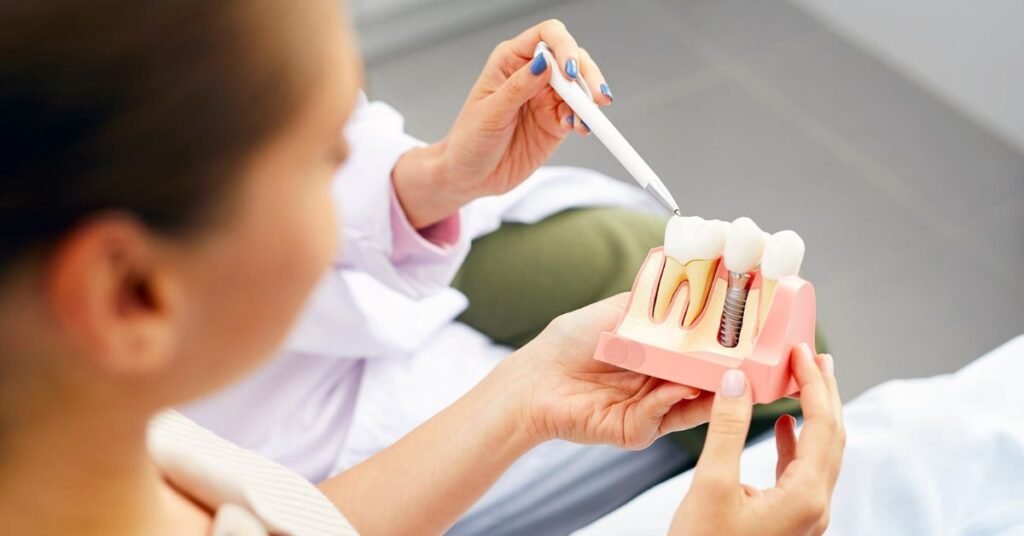
Dental implants are small, usually titanium, posts placed into the jawbone to support replacement teeth. Once the implant has integrated with the bone, it can support a dental crown, bridge or full-arch replacement, depending on your needs.
Dental implants are designed to restore chewing function, support your smile and provide a long-term option for replacing missing teeth.
Many adults with missing teeth may be suitable for dental implants. Your suitability depends on factors such as your general health, gum condition, jawbone volume, oral hygiene and smoking habits.
A dental implant consultation and appropriate investigations can help determine whether implants are suitable for you and whether additional procedures may be needed.
Dental implants, dentures and bridges each have advantages. Implants are supported by the jawbone, whereas conventional dentures rest on the gums and traditional bridges rely on neighbouring teeth for support.
The most appropriate option depends on your oral health, the number of missing teeth, your preferences and your budget. Your dentist can explain the benefits and limitations of each option.
Yes. Multiple dental implants can support several replacement teeth. Depending on your circumstances, an implant-supported bridge or a full-arch restoration may be appropriate.
The number and position of implants required will depend on your bone structure, bite and treatment plan.
Yes, full-mouth or full-arch implant treatment may be an option for people who have lost most or all of their teeth, or whose remaining teeth cannot be predictably maintained.
Options may include All-on-4 or All-on-6 dental implants. The recommended approach depends on your bone structure, oral health and individual clinical assessment.
All-on-4 and All-on-6 are full-arch treatment approaches that use four or six implants respectively to support a replacement set of teeth.
All-on-4 uses four implants, while All-on-6 uses six. Neither option is automatically better for every patient. Your dentist will assess your jawbone, bite and overall oral health before recommending a suitable approach.
Dental implant treatment generally involves several stages:
The exact stages and timeline vary depending on your treatment needs.
A bone graft is a procedure that may help rebuild or increase jawbone volume when there is insufficient bone to support an implant.
A sinus lift is a specific type of bone augmentation procedure used in some cases involving the upper back jaw, where additional bone height is needed near the sinus.
Not every patient requires these procedures. Your dentist will assess your bone structure and explain whether either procedure may be beneficial.
Possibly. Some patients with reduced jawbone volume can still receive dental implants following suitable assessment and, where appropriate, bone grafting or other preparatory treatment.
Your options depend on the extent and location of the bone loss, your gum health and the available treatment techniques.
In selected cases, an implant can be placed immediately after a tooth is extracted. However, immediate implant placement is not suitable for everyone.
The decision depends on factors such as infection, bone quality, gum condition and implant stability. In other cases, your dentist may recommend allowing the extraction site to heal first.
Dental implant placement is usually performed under local anaesthesia to help minimise discomfort during the procedure. You may experience soreness, swelling or bruising afterwards.
Your dentist will explain how to manage discomfort and provide aftercare instructions based on your procedure and individual needs.
Initial recovery often takes several days to around one or two weeks, although this varies depending on the complexity of the procedure.
The implant itself usually needs several months to integrate with the jawbone before the final restoration can be completed. More complex treatments, including bone grafting, may require additional healing time.
The overall treatment timeline varies from patient to patient. Some cases can be completed in a few months, while others take longer because of healing requirements or additional procedures.
Your dentist will provide an estimated timeline after assessing your oral health and developing your treatment plan.
You will generally need to choose soft foods initially and avoid putting excessive pressure on the surgical area. Your dentist will advise when you can gradually return to your usual diet.
If you receive temporary teeth or a full-arch restoration, you may need to follow specific dietary instructions while healing.
Many patients can return to normal daily activities within a short period, but this depends on the extent of surgery and how they feel afterwards.
You may need to take time off if your procedure is complex or your work involves strenuous physical activity. Follow your dentist’s advice regarding rest and recovery.
Dental implants can last for many years, and some remain functional for decades. However, their longevity is not guaranteed.
Good oral hygiene, regular dental reviews, healthy gums and avoiding smoking can help maintain your implants. The crown, bridge or denture attached to the implant may need maintenance or replacement over time.
Care for dental implants by brushing twice daily with fluoride toothpaste, cleaning carefully between your teeth and around the implants, and attending regular dental and hygiene appointments.
Your dentist or hygienist can recommend suitable brushes and interdental cleaning tools for your particular restoration.
Although dental implant treatment has a high success rate, complications can occur. These may include failure of the implant to integrate with the bone, infection, gum inflammation or problems with the restoration.
Smoking, uncontrolled diabetes, poor oral hygiene and certain other factors can increase risks. Regular monitoring helps identify problems early.
Smokers may still be considered for dental implant treatment, but smoking can impair healing and increase the risk of complications and implant failure.
Your dentist will discuss the risks and may recommend stopping smoking before and after surgery to improve the chances of successful healing.
Our friendly team is here to help. Get in touch and we’ll be happy to discuss your options and guide you through the next steps.
Book a Dental Implant Consultation
Whether you need a single tooth replacement, multiple implants, All-on-4, All-on-6 or full-mouth treatment, an individual assessment is the first step.
Experienced Dental Team
Modern Technology & Techniques
Personalised Treatment Plans
Conveniently Located in Liverpool